Thursday, 25 October 2012

Warbler Fest

What a busy week, have been having to juggle university commitments and birding a lot this week, but it has thankfully worked well. On Saturday the 20th I decided I would go and see the Eastern Olivaceous Warbler in Fife, I saw the bird at Flamborough Head on the 1st of September 2010. However I did not see this bird well at all and I had said to myself that if another turned up I would go and see it. Therefore when a bird turned up in Fife and was showing well I could not resist, the bird performed very well with tail pumping seen and the bird constantly ‘tacking’. Whilst there we were informed a Radde’s Warbler had been found some 100 yards away, after an anxious and fairly long wait the Radde’s Warbler showed well with great views allowing to see the apricot underparts and broad and obvious supercilium. On the way out I also stopped to see the Red-breasted Flycatcher which performed really well and was another great bird to see.

 (Eastern Olivaceous Warbler - copyright Mike Thrower)

(Eastern Olivaceous Warbler - copyright Mike Thrower)

Monday started well when a Pallas’s Warbler was trapped and ringed at Whitburn Coastal Park, some minutes later I was standing at the ringing hut at Whitburn and was soon presented with a stunning Pallas’s Warbler. This is the first one I have ever seen in Durham, I also heard Brambling going over but I did not see it. Later on in the day a Red-breasted Flycatcher was trapped and ringed, this was a bird I had not previously seen in the hand and was an absolute pleasure to see. I did see the Pallas’s Warbler in the field sometime after its release briefly as it flitted around with some Goldcrests, was a bonus to see it in the field as I managed to get cracking views of that lemon yellow rump flashing about as it moved around the sycamores.

(Pallas's Warbler - copyright Andrew Kinghorn)

(Pallas's Warbler - copyright Andrew Kinghorn)

(Red-breasted Flycatcher - copyright Andrew Kinghorn)

(Red-breasted Flycatcher - copyright Andrew Kinghorn)

Tuesday saw a Dusky Warbler trapped and ringed, later on in the day a Rustic Bunting was seen briefly but then not found later on in the day. At the coastal park a Ring Ouzel was also trapped, was great to see this species up close and personal after having seen it many times in the past over in the Durham dales. I haven’t actually seen many coastal Ring Ouzels so this was a welcome treat to see up so close.
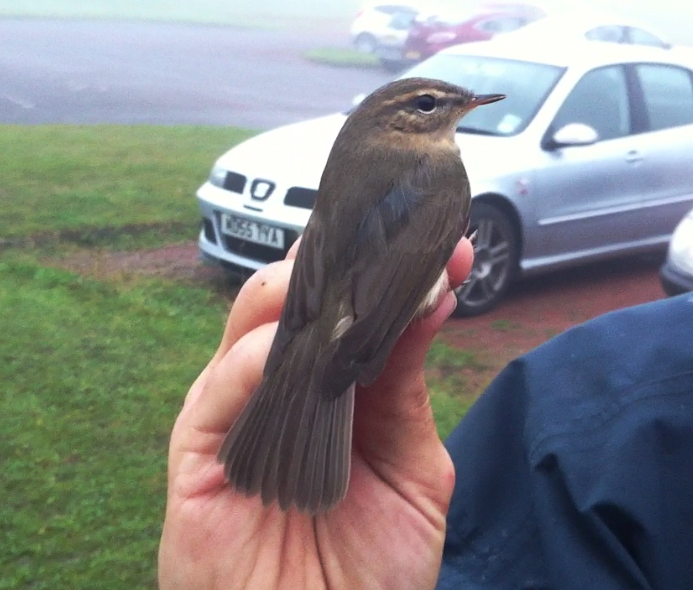
 (Dusky Warbler - copyright Andrew Kinghorn)

(Dusky Warbler - copyright Andrew Kinghorn)


(Ring Ouzel - copyright Andrew Kinghorn)

(Ring Ouzel - copyright Andrew Kinghorn)

Wednesday was generally not very productive with only brief views of the Dusky Warbler but little else except a Jack Snipe and a Common Snipe. However some new Chiffchaffs were fresh in and hanging around with the tit flock. Today (Thursday) I had good views in the field of the Dusky Warbler and also heard the bird ‘tacking’ as it went about its business. I also had a very good view of my first and only Black Redstart of the year in the Souter Lighthouse garden. A Barred Warbler was nearby but I did not see it, apparently around feeding on elderberries across the road from the lighthouse.

Until next time, Foghorn out!

Tuesday, 16 October 2012

Autumn thus far....


Its been a fairly long while since I have updated my blog, the birding has been good and I am now back at University and so the workload had gone from zero to a ridiculous amount, I am also trying to get on top of writing my species accounts for the Durham Bird Club annual report. Just got the Owls to do!

Since my last post I have as always done lots of birding; however I have nothing generally to report apart from prolonged periods of boredom finding very little. If there’s nothing at the coast and the weather is poor it’s a bit of a washout, though I imagine I am preaching to the converted.

A few Saturdays ago I made the decision to head down to South Yorkshire to see the female Pallid Harrier. I am a bit of a fan of BOP’s and I had never seen this age or sex of this species anywhere in the world so I went for a look. The bird had roosted the previous evening and so I was on site for dawn, at around 7.00AM the bird came out of the roost, flew up over the surrounding fields and away out of sight. It was all over so suddenly but the chance to enjoy the bird was not missed, it was clear to see the unstreaked lower belly, dark underwing contrasting with the pale hand, and of course the 4 primaries all counted and accounted for. Nice! I spent the rest of the day dipping a Rose-coloured Starling in Notts that had turned up whilst I was stuffing my face with McDonalds junk (sponsor me? Get in touch). Turns out that after 3 hours of unsuccessful searching the bird was seen in October…..2011! DOHHHHHHHHH! Now that’s late news, so close and yet so far.

Little action took place until Friday when on my day off Uni I decided to investigate the rather early and unseasonal arrival of a Hume’s Warbler at Cambois in Northumberland. After around an hour the bird started calling and was located, I had pretty good views of the bird which did appear to be quite bright but did call perfectly for Hume’s Warbler on more than one occasion. I then spent the afternoon dipping on another Pallas’s Grasshopper Warbler in Whitburn, but the fact I had seen on in the hand really did not make this dip painful at all.

Saturday was an interesting day, the day started off with a call from Stringer. Much to my delight there was a Paddyfield Warbler at St Mary’s Island. I shot off down and was soon at St Mary’s Island and after a short while a bird gave itself up. In true typical ‘acro’ style the bird shot across in from of the crowd, perched in a willow before diving down into cover. I had to wait a while until the bird finally gave itself up. It showed well, allowing for study. It was evident that from these views this particular bird was not the Paddyfield Warbler but a Blyth’s Reed Warbler. The short primary projection was evident and the plain tertials and white underparts made the bird stand out, the lack of any strong head and facial markings eliminated Paddyfield Warbler from the mix. I saw the bird again on one more occasion well and also saw a Reed Warbler during the twitch. A Yellow-browed Warbler was consistent in its calling and I got good views of the bird in the willows briefly before it flitted off going back to feeding actively. Pretty decent afternoon, Blyth’s Reed Warbler is also a British tick for me. Score!

Sunday was a fairly uneventful birding day, with little really of note. Then at around 3ish news came through of a male Pied Wheatear on Holy Island. I got that twitchy feeling and had already decided so long as I could get across I would go and see the bird, I was sort of hesitating due to tide times but decided I could probably get across to Holy Island, rush along to the bird, enjoy it for a while and then leave contented. That’s exactly what happened. What a fantastic bird! The images and video really (as always to be honest) don’t do the bird justice. Another lifer, what a weekend! I've had a good autumn so far. 

Even a Gannet turned out to twitch the Pied Wheatear:
 (A rather friendly Gannet! - copyright Andrew Kinghorn)

 (Gannet - copyright Andrew Kinghorn)

(Pied Wheatear - copyright Andrew Kinghorn)

(Pied Wheatear - copyright Andrew Kinghorn)

Monday, 1 October 2012

Pallas's Grasshopper Warbler

This bird has certainly left a lasting impression on me, its' just another one of those species I was not expecting to see. I really like locustella warblers and so the chance to see this magical rare bird was a real treat indeed. Mostly people just glimpse these birds, however to get one in the hand in your own county is rather special.

I knew the species was a bit of a Shetland speciality, however when doing research I soon realised just how rare the species was away from Shetland! Providing the most recent 3 records are accepted here are all the British records of Pallas's Grasshopper Warbler away from Shetland.

1976 - Norfolk - Cley 
1985 - Northumberland - Farne Islands
1993 - Orkney - North Ronaldsay
1996 - Dorset - Portland
2001 - Norfolk - Blakeney Point
2001 - Northumberland - Newbiggin-by-the-Sea
2008 - East Yorkshire - Spurn
2009 - Outer Hebrides - St Kilda
2010 - Durham - Whitburn
2012 - Durham (also Cleveland) - Hartlepool 
2012 - Durham - Whitburn Coastal Park
2012 - Aberdeenshire - Mains of Slains

Now lets strip the ones that were not on the mainland; birds that were on an island and so harder to get than mainland birds:

1976 - Norfolk - Cley
1996 - Dorset - Portland
2001 - Norfolk - Blakeney Point
2001 - Northumberland - Newbiggin-by-the-Sea
2008 - East Yorkshire - Spurn
2010 - Durham - Whitburn
2012 - Durham (also Cleveland) - Hartlepool
2012 - Durham - Whitburn Coastal Park
2012 - Aberdeenshire - Mains of Slains

Away from Shetland, Durham is not the best county in the UK in which to see Pallas's Grasshopper Warbler, not just mainland but the whole of the UK. Just gives me more appreciation of the event.

(PG Tips - copyright Andrew Kinghorn)

Until next time, Foghorn out!

Saturday, 29 September 2012

Migrants!

Can everyone remember what they look like? Before I get to the weeks highlights I best start off with last week.

Last Saturday saw me making the jouney north to Goswick in the afternoon, I was aware the Buff-breasted Sandpiper was around. I had only previosuly seen the species once back in September 2009 on Back Saltholme (if I have remembered that correctly?), it was distant and views were poor. I like seeing pics of Buff-breasted Sandpipers and I am often a little envious when looking at images of them close up and affording observers mega views, with this in mind I went up to Goswick and managed to connect with the bird after around 45 mintutes. I picked it up flying in from the south and landing on the mud flats with 2 Dunlin nearby. Stalked the bird and was afforded mega views of this stunning Yank wader.

Poor video grab of a mega bird:
(Buff-breasted Sandpiper - copyright Andrew Kinghorn)

(Buff-breasted Sandpiper - copyright Andrew Kinghorn)

Sunday was quiet, a Lesser Whiethroat may have been a Headland tick? A seawatch was okay, though I had to go home and defrost afterward. Highlight was certainly the drake Velvet Scoters flying south past the Headland. Monday was an interesting day, I'll not go into the in's and out's of it all but I made a few stupid decissions. One did pay off though when I was having mega views of a Red-breasted Flycatcher at Zinc Works Road, quite unlike my first which was a skulker and murder to get good views off. 

Tuesday things started to kick off, was very frustrating though. I am now back at univeristy and so time to birdwatch is limited, I wanted to be out looking for migrants but instead I was stuck indoors 'studying'. I break in the uni stuff provided me with a long awaited lifer when Mark Newsome found a Common Rosefich at Whitburn Coastal Park. When I arrived there was no sign, however some patients provided the goods and the bird flew in from high and landed on the berries and started to feed, I had good views and returned later for even better views! They looked bad in books but actually juveniles aren't all that bad; they have something about them, maybe its just the wing bars. Marsden Hall produced my second Red-breasted Flycatcher but there was no sign of the Barred Warbler which had presumably moved on. 

Wednesday was a day to remember, my chance at a Pallas's Grasshopper Warbler at Hartlepool Headland was gone. Only 4 birders saw the bird, a real testament to time in the field. I was gutted, a species I knew I would probably never get a chance to see in Durham again. Then in early afternoon I got a phone call from Mark Newsome, I can remember 'Pallas's Grasshopper Warbler' follwed later on by 'caught at Whitburn'. AGGHHHHH PANIC! I was on site 10 minites later (I just left uni for the day) and was standing shaking with excitement and nerves, I calmed down a bit and waited until the bird was shown around. What an absolute beauty! I never thought I would be seeing a Pallas's Grasshopper Warbler anytime soon in Durham; if ever! 

Look at that!
(Pallas's Grasshopper Warbler - copyright Andrew Kinghorn)

Mega, mega, mega! Bird was released into the small mound and seen only by a few fortunate observers on the evening. I headed down to The Leas hedge where I had views of Yellow-browed Warbler and Whinchat, a good way of rounding of a memorable day. Congradulations to Chris Bell, who is now the only bloke in the to have ever seen 2 Pallas's Grasshopper Warblers in the same day in the UK. Both in same county as well.

Thursday was a lot quieter and a search for migrants after uni was in vain, though movement of Barnacle and Pink-footed Geese is always good to see. 

Friday...well you will have to wait till my next blog post.

Until next time, Foghorn out!